Store
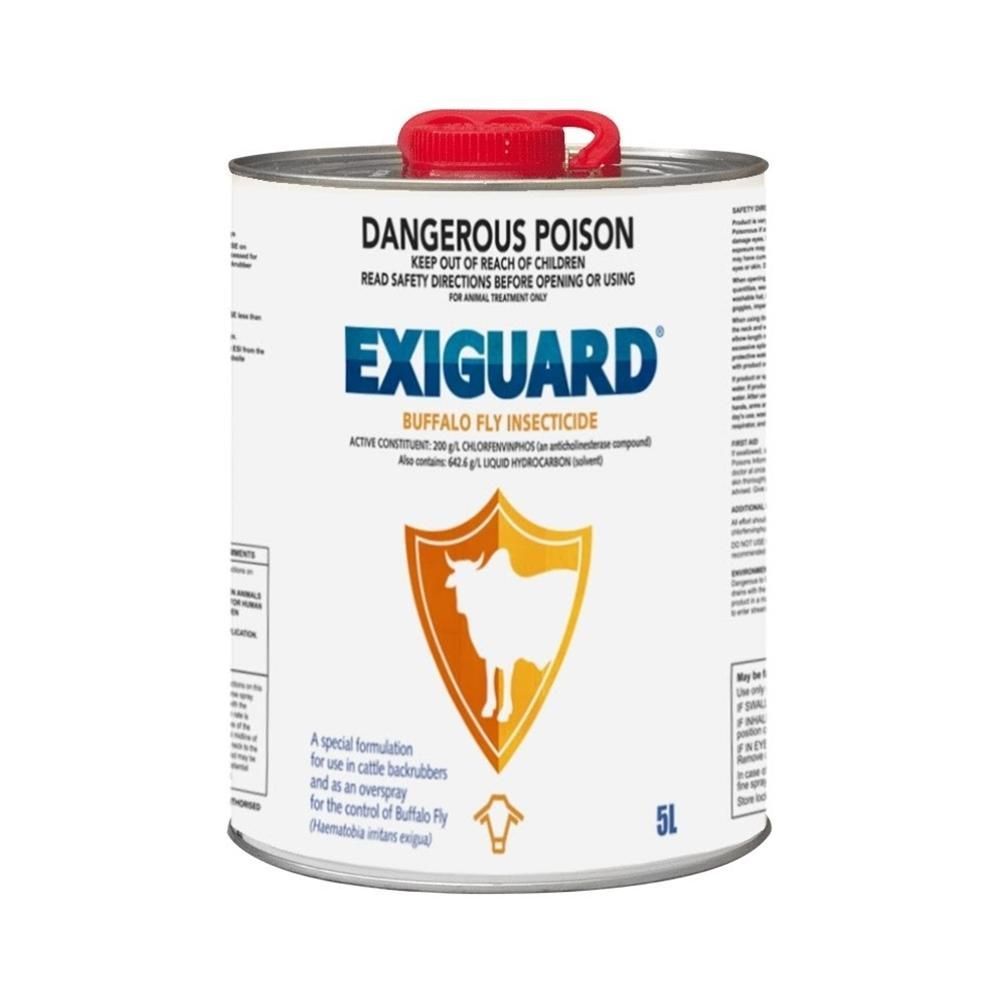
Exiguard Buffalo Fly Insectide - 5 litres
Effective Buffalo Fly Control for Beef and Dairy Cattle
Protect your cattle against troublesome buffalo flies with Exiguard Buffalo Fly Insecticide 5 Litres, a specialised Australian-made insecticide formulated for the control of buffalo fly ( Haematobia irritans exigua ) in cattle.
Containing 200g/L chlorfenvinphos, an organophosphate insecticide, Exiguard is designed for use in cattle backrubbers and as an overspray, according to its registered label directions.
Buffalo flies can cause significant irritation, discomfort and stress in cattle. Heavy infestations may contribute to reduced grazing time, skin irritation and production losses.
Exiguard provides cattle producers with two application options for managing susceptible buffalo fly populations during the fly season.
Registered for specified uses in Queensland, New South Wales, Western Australia and the Northern Territory, Exiguard is suitable for beef cattle and, by the permitted overspray method, dairy cattle.
Pack Size: 5 Litres
Important: Schedule 7 Dangerous Poison. This product is subject to legal supply, handling and use restrictions.
Key Features & Benefits
- Buffalo Fly Control – Formulated to control buffalo fly infestations in cattle.
- 200g/L Chlorfenvinphos – Contains an organophosphate insecticide.
- Two Application Methods – Registered for cattle backrubber and overspray use.
- Beef Cattle Use – Suitable for labelled backrubber or overspray applications.
- Dairy Cattle Use – Permitted as an overspray according to label restrictions.
- Seasonal Parasite Management – Suitable for inclusion in an appropriately managed buffalo fly control program.
- 5 Litre Container – Practical size for cattle producers and rural properties.
- Australian Made – Manufactured for the Australian agricultural market.
- Registered Veterinary Insecticide – APVMA approval number 84897/111714.
What Is Exiguard Buffalo Fly Insecticide?
Exiguard is a veterinary insecticide formulated specifically for the treatment and control of buffalo fly in cattle.
Its active ingredient, chlorfenvinphos, belongs to the organophosphate chemical group.
It is an anticholinesterase compound that interferes with normal nervous system function in susceptible insects.
Exiguard is registered for application through cattle backrubbers and as an overspray, with different directions and restrictions for each method.
It is not a general-purpose insecticide for use on other livestock, pets, people or household surfaces.
Why Buffalo Fly Control Is Important
Buffalo flies are small, blood-feeding insects that commonly infest cattle in warmer regions of Australia.
Unlike many other flies, buffalo flies spend much of their adult life on cattle, repeatedly feeding on the animal.
Problems Associated with Buffalo Flies
- Persistent irritation and discomfort
- Excessive tail switching and head shaking
- Increased rubbing and scratching
- Skin damage and sores
- Reduced grazing efficiency
- Stress in affected cattle
- Potential production losses during heavy infestations
Effective buffalo fly management can contribute to improved animal welfare and more comfortable grazing conditions.
Suitable for Beef & Dairy Cattle
Exiguard has different registered applications depending on cattle type.
Beef Cattle
Registered applications include:
- Cattle backrubbers
- Overspray
Dairy Cattle
Registered application:
- Overspray, according to the product label
Do not use Exiguard by backrubber application on lactating cows producing milk for human consumption.
Application Methods
Exiguard must only be used according to the current registered label.
Cattle Backrubbers
Backrubbers provide a method of applying insecticide to beef cattle as they make contact with a treated rubbing device.
The product is mixed with a specified clean oil carrier according to the label.
The backrubber must be maintained and used within the manufacturer's prescribed application limits.
Backrubber application is restricted to the cattle types and circumstances specified on the label.
Cattle Overspray
Exiguard may also be applied as a coarse overspray to beef and dairy cattle.
Correct dilution, spray coverage and treatment intervals are essential.
Operators must follow all registered directions, including the minimum retreatment interval and maximum number of treatments permitted annually.
Registered States
The labelled buffalo fly applications apply in:
- Queensland
- New South Wales
- Western Australia
- Northern Territory
Do not assume that the same uses are registered in other Australian states.
Application Restrictions
The registered label specifies important restrictions, including:
- Do not repeat overspray treatment at intervals of less than 10 days.
- Do not carry out more than 18 overspray treatments in one year.
- Do not allow cattle access to treated backrubbers for more than 40 weeks in a year.
- Remove backrubbers at the end of the buffalo fly season.
- Do not treat cattle concurrently with, or within 10 days of, other organophosphate treatments.
- Do not use backrubber application on lactating cows producing milk for human consumption.
Refer to the current registered label for complete preparation, application and safety instructions.
Active Ingredients & Product Composition
| Component | Concentration |
|---|---|
| Chlorfenvinphos | 200g/L |
| Liquid hydrocarbon solvent | 642.6g/L |
Chemical Group: Organophosphate
Chemical Action: Anticholinesterase insecticide
Poisons Schedule: Schedule 7 – Dangerous Poison
Meat & Milk Withholding Periods
The published Exiguard label provides the following withholding information.
| Application | Withholding Requirement |
|---|---|
| Meat | 0 days |
| Milk – permitted overspray | 0 days |
| Milk – backrubber | Not permitted on lactating cows producing milk for human consumption |
| Export Slaughter Interval – backrubber | 10 days |
| Export Slaughter Interval – overspray | 0 days |
Important: Confirm current withholding periods and export slaughter intervals against the registered label and current APVMA advice before treatment.
Managing Buffalo Fly Resistance
Buffalo fly populations can develop resistance to insecticides.
For effective long-term management, cattle producers should use an integrated parasite control program.
This may include:
- Monitoring buffalo fly numbers
- Identifying when treatment is necessary
- Selecting appropriate registered insecticides
- Considering chemical group rotation
- Following all labelled application rates
- Avoiding unnecessary repeat treatments
- Seeking veterinary or agricultural advice where resistance is suspected
Changing product brands does not necessarily mean changing insecticide chemical groups.
Frequently Asked Questions – Exiguard Buffalo Fly Insecticide
What is Exiguard Buffalo Fly Insecticide used for?
Exiguard is used to control buffalo flies on cattle. It is registered for specified backrubber and overspray applications in Queensland, New South Wales, Western Australia and the Northern Territory.
What is the active ingredient in Exiguard?
Exiguard contains 200g/L chlorfenvinphos, an organophosphate anticholinesterase insecticide.
Can Exiguard be used on dairy cattle?
Yes, by the permitted overspray method. It must not be used by backrubber application on lactating cows producing milk for human consumption.
Can Exiguard be used in cattle backrubbers?
Yes. Backrubber use is registered for beef cattle under specified conditions. Follow the current label for mixing, charging and maintenance requirements.
Is Exiguard suitable for buffalo fly control in NSW?
Yes. New South Wales is one of the states included in the product's registered directions for use.
Is Exiguard suitable for horses?
No horse use is established by the registered cattle label reviewed. Do not use Exiguard on horses unless a current approved label specifically authorises that use.
Does Exiguard control ticks or lice?
Exiguard's reviewed registered claims concern buffalo fly. Do not assume it is approved for ticks, lice or other parasites.
What is the meat withholding period for Exiguard?
The published label specifies a zero-day meat withholding period. Export slaughter intervals differ by application method and must also be observed.
Can Exiguard be used on lactating dairy cows?
The permitted overspray method may be used according to the label. Backrubber treatment must not be used on lactating cows producing milk for human consumption.
Is Exiguard a Schedule 7 poison?
Yes. Exiguard is classified as a Schedule 7 Dangerous Poison and requires appropriate handling, storage, supply and safety precautions.
Where can I buy Exiguard Buffalo Fly Insecticide 5L in Australia?
Contact Pet Essentials at www.petessentials.com.au to enquire about product availability, purchasing eligibility and permitted collection or delivery arrangements.
Product Specifications
Brand: Exiguard
Product Name: Exiguard Buffalo Fly Insecticide
Pack Size: 5 Litres
Product Type: Veterinary Insecticide
Active Ingredient: Chlorfenvinphos
Concentration: 200g/L
Solvent: Liquid Hydrocarbon 642.6g/L
Chemical Group: Organophosphate
Poisons Schedule: Schedule 7
Target Pest: Buffalo Fly ( Haematobia irritans exigua )
Animal Species: Beef and Dairy Cattle, Subject to Label Restrictions
Application: Backrubber or Overspray
Registered States: QLD, NSW, WA and NT
APVMA Approval: 84897/111714
Registrant: The Hunter River Company Pty Ltd
Country of Manufacture: Australia
Safety, Storage & Handling
DANGEROUS POISON – KEEP OUT OF REACH OF CHILDREN
Exiguard contains a toxic organophosphate insecticide and a flammable hydrocarbon solvent.
- Read the complete registered label and Safety Data Sheet before use.
- Wear the protective equipment specified by the label and SDS.
- Avoid inhaling vapours, mist or spray.
- Avoid contact with skin and eyes.
- Do not eat, drink or smoke while handling.
- Use only in appropriately ventilated areas.
- Keep away from heat, sparks and ignition sources.
- Store below 30°C in its original closed container in a suitable, ventilated and secure location.
- Store separately from food, animal feed and drinking water.
- Prevent contamination of waterways.
- Follow label directions for spills, disposal and environmental protection.
- Observe all relevant workplace and chemical handling requirements.
Australian Poisons Information Centre: 13 11 26
In an emergency involving serious exposure or poisoning, call 000.